
文档快照。请在独立的 NorthCUA Harness 仓库 中运行命令。
From a task to an inspectable outcome
A computer-use task starts with a request and a software workspace. The agent needs to connect individual operations into a workflow, and the resulting state needs to be checked against the request. The NorthCUA Harness in NorthCUA keeps these activities associated with the same task attempt: prepare the workspace, execute, evaluate, save evidence, then release resources.
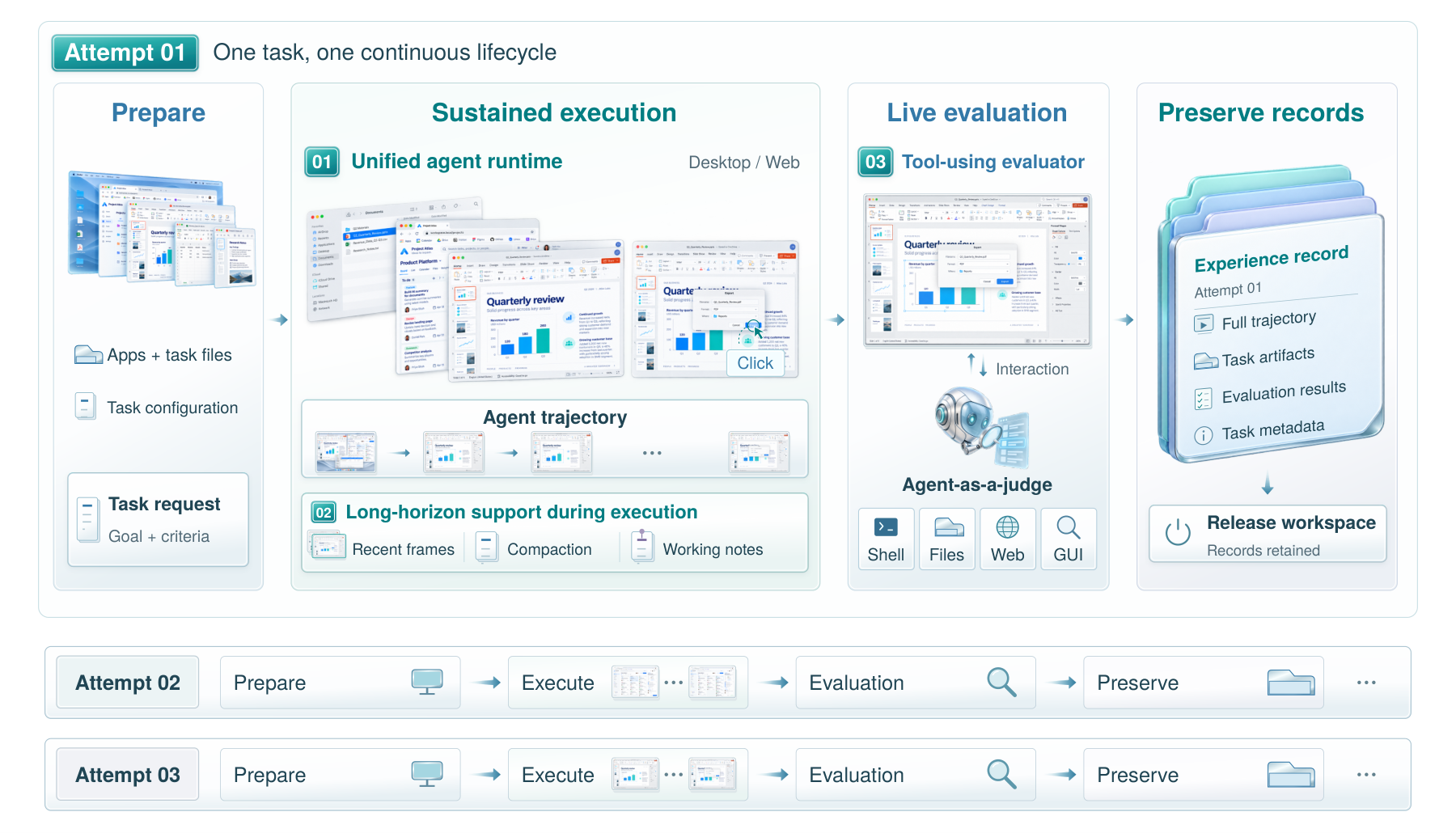
Research illustration from the 2026-10-03 NexCUA draft. GUI scenes and trajectories are schematic. Figure provenance identifies the source artwork.
One execution foundation, two interaction surfaces
Desktop observes screenshots and acts through mouse and keyboard tools. Web combines screenshots with DOM-derived information and browser operations. Each supplies its own observation and action implementation to a shared runtime built on public NexAU.
The runtime organizes work into sessions, rounds, and steps. A session identifies an ongoing interaction and its records; a round handles one user request; a step invokes the policy and dispatches its tool calls. This common structure lets context services, evaluation, telemetry and task management work across both agents.
Use local execution to begin. Move tools to a device worker when the software runs on another machine.
Keep the next decision informed
Long workflows create two kinds of information: a full record for inspection and a bounded context for the next decision. NorthCUA retains the record while projecting a smaller view through three complementary mechanisms.
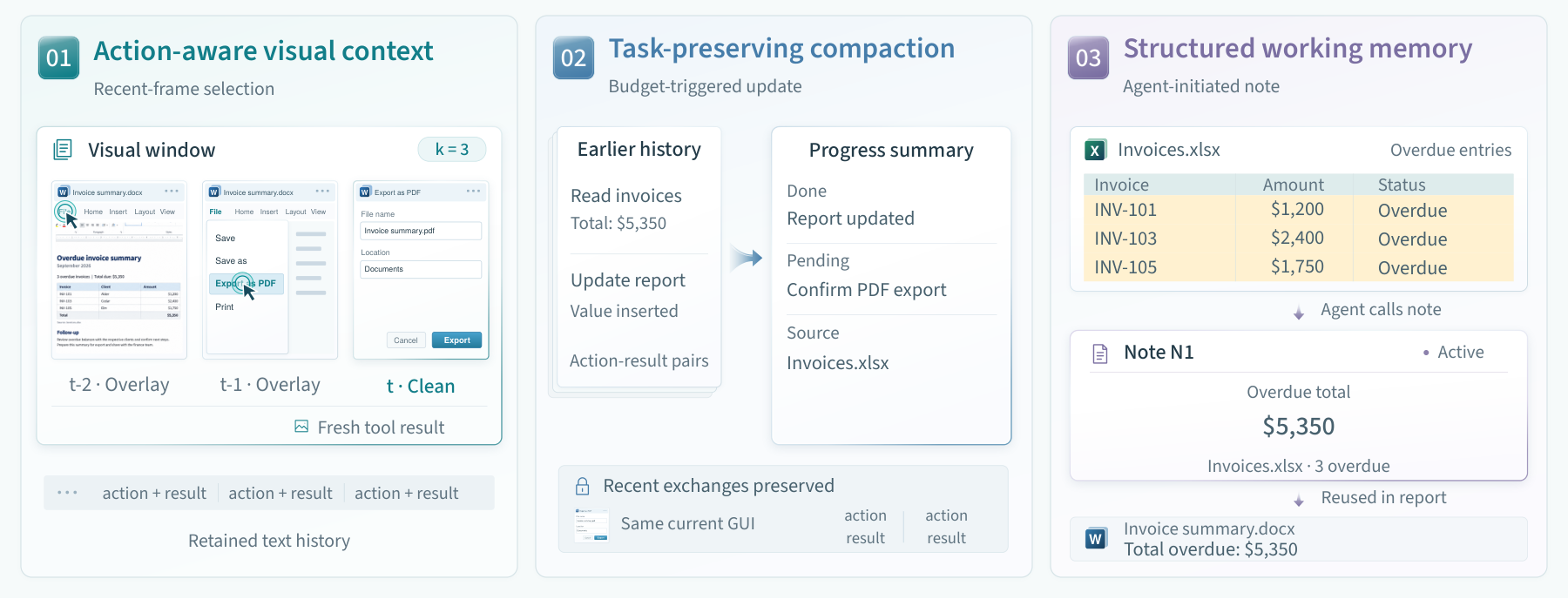
The report's invoice example is illustrative. It stops before PDF export is confirmed; it is not a successful benchmark trajectory from this release.
Visual context keeps the newest clean state and selected recent action overlays. An overlay describes an operation on its pre-action screen; the clean image shows the resulting state. Web Set-of-Mark annotations share the total image budget.
Task-preserving compaction summarizes eligible older exchanges while protecting the request, current observations and unfinished interactions. A summary can retain a source value and an outstanding export requirement after routine navigation leaves the prompt.
Working memory lets the agent deliberately retain a fact, constraint, correction or
checkpoint through note / web_note. A stable key replaces the active value while the
underlying event record remains durable. The active view is bounded and supplied separately
from chronological history. See context and memory for configuration and limits.
Inspect the outcome while the workspace is available
An actor's terminal message establishes what it reports. Evaluation gathers evidence about what it accomplished. NorthCUA's evaluator can retrieve selected steps and saved artifacts, then use authorized live tools to answer questions that the trace alone cannot settle.
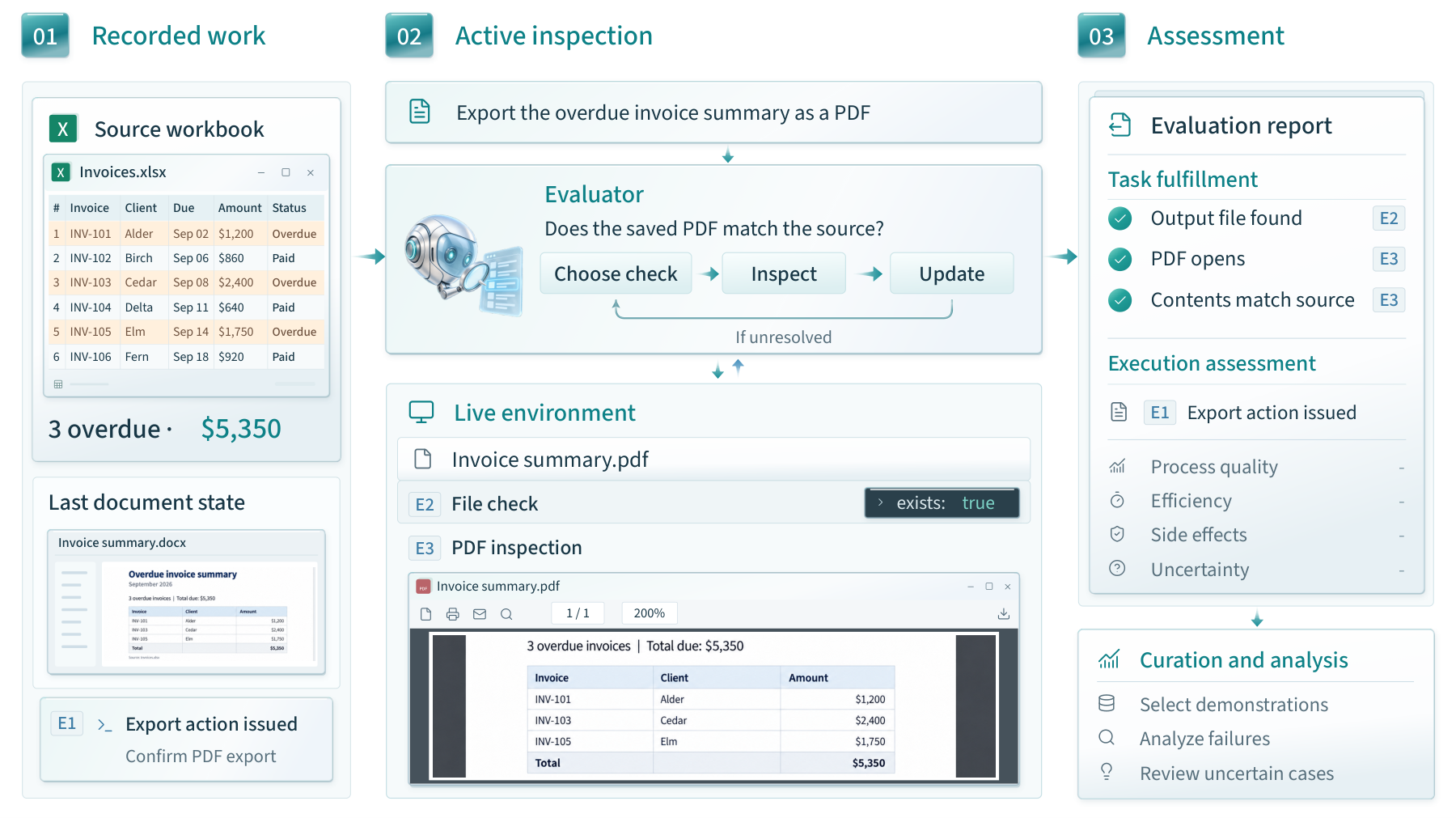
Illustrative inspection sequence from the report. The clean implementation exposes recorded evidence, authorized live probes and structured reports; this figure is not validation of an actual exported document.
For Web, live probes reuse the actor's browser session. A reload or replacement browser could erase unsaved application state, so assessment runs before browser release. Evaluator operations have their own record, and outcome judgments remain separate from actor termination. Evaluation and artifacts explains the lifecycle and how to inspect or re-evaluate a run.
Coordinate many isolated attempts
The controller assembles model requests and dispatches tools to device workers. Batch orchestration manages creation, execution, inspection, record delivery and cleanup, with persistent task claims and recovery state. A prepared environment belongs to one upcoming task attempt; it is consumed once. Preparation can overlap another attempt's execution without carrying application state across tasks.
The resulting files support debugging, evaluation and downstream research integrations. Training and experience-production pipelines are outside this repository's release scope. See batch execution for manifests and recovery, and the verification matrix for actual deployment evidence.
Reproduce the small, real-browser check
The integration fixture serves a page and a deterministic model endpoint on localhost. The actor records a note, clicks a button and finishes. The evaluator then inspects a DOM marker that would disappear after a reload. Passing establishes that the actual tool, model-provider and evaluator paths shared the intended page state.
uv sync --locked --extra local --extra device --extra dev
uv run --no-sync playwright install chromium
NORTHCUA_RUN_BROWSER_TESTS=1 uv run --no-sync pytest tests/integration/test_web_modes.py -q
This is a reproducible wiring check without model credentials. For actual model quality, run a declared task set with the intended model, budgets and evaluator, and retain its artifacts separately from these fixtures. Testing lists the other checks.